Friday, April 27, 2012

Uses of a Rubber Tree | Rubber

Rubber Tree

Rubber Tree—Ken Doerr (Flickr.com)

Countries like Indonesia, the Philippines, Brazil, and India cultivate rubber by way of the rubber tree. It has many uses, chief amongst them rubber latex for many products.

Ancient Mayans actually used an earlier version of rubber latex to form a ball for sporting events. These days, many household materials rely on this main ingredient for housekeeping. It can be found in rubber rain boots, gloves for dishwashing and laundry, rubber bands, pencil erasers, mats, and other rubber goods. As well, the automobile industry uses a lot of this harvested rubber tree product to protect car windows and doors, and to manufacture hoses, tubes, and belts for the engine.

Rubber has also gone on to become part of the textile industry, though it is largely an unconventional “fabric” for garments and furniture upholstery. While many might instantly think of the fetish subculture when they hear the words “rubber” and “clothes” in one sentence, spandex, a synthetic offshoot of rubber, has become a mainstream clothing component. Many gym and athletic clothes, including swimsuits, now use spandex…and even clothes meant to be worn regularly use it, as well.

Spandex high fashion

Spandex high fashion—S MiRK (Flickr.com)

Rubber is also apparent in toys. Balls, trampolines, blocks, toy car tires and parts, dolls, floating devices, and even balloons rely on rubber trees to be created. Rubber is relatively cheap to produce but it is hard to break, making it an ideal component for toys. These days, parents and guardians are concerned about reports on the allergic reaction of their kids over plastic toys. Playthings made of natural rubber can replace these, because they carry no harmful toxins, last long, and are even sustainably harvested so they help the economy.

travel to india: Cherrapunjee - the East Khasi Hills


Cherrapunjee - the East Khasi Hills

Cherrapunjee is situated in the East Khasi Hills District of the state of Meghalaya. Sitting on the top of a mountain with a bonfire is just one of the normal days in Cherrapunjee. A night will take you on a journey of stars where life is not just usual; it's a feeling of being extraordinary.

The lower reaches of the southern slopes of Khasi and Jaintia hills are humid and warm and are streaked by many swift flowing rivers and mountain streams.  A species of Indian Rubber tree - botanical name: Ficus elastica - thrives and flourishes alongside these streams and rivers.

This tree can comfortably perch itself on huge boulders along side the riverbanks or in the middle of rivers and send its roots down to the riverbed.  Thus, they have adapted themselves very well to high soil erosion caused by these fast flowing rivers and streams that come down about 3000 feet along precipitous slopes.

Cherrapunjee holds two Guinness World Records; one for having the maximum amount of rainfall in a single year between August 1860 and July 1861. The second record is for the maximum amount of rainfall in a single month, in July 1861. This region experiences an annual average rainfall of around 11,430 metres. Further, it is the only place in India which experiences monsoon all year round.


The average annual rainfall at Cherrapunjee from 1973-2011 (39 years) is 11,820.8 mm (i.e. 38.78 feet- i.e. 453.36 inches). Due to two consecutive years (2005 & 2006) of below average rainfall the average had been pulled down to under 12,000 mm.

Thursday, April 26, 2012

Living Infrastructure: Grow-it-Yourself Jungle Bridges | WebUrbanist

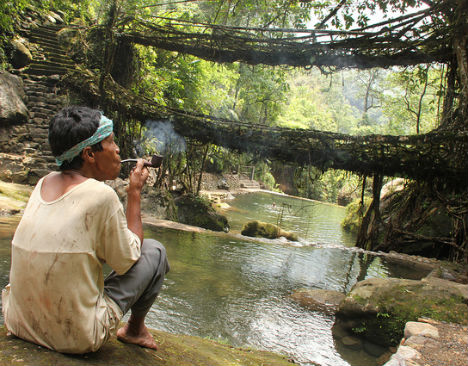
In sunny weather, the calm pools of water in Nongriat are the perfect place to bathe or relax, their waters typically shallow enough to stand in. But this peacefulness is rare, and when the rain comes – as it so often does – the locals need bridges that are stronger than steel in order to cross. Their solution? Growing their own. A native species of rubber tree is the ideal medium for living bridges that can withstand rivers that run with deadly force.

(images via: arshiya bose)

This area of Meghalaya, India gets an astonishing 49 feet of rain on average each year. Flash floods come quickly and without warning. So, long before modern engineers began designing the kinds of bridges that could hold up to such conditions, the locals here found a way around the problem.

(image via: rajkumar1220)

For 500 years, they have been manipulating the secondary roots of the ficus elastica, which grow along the length of the trunk. The roots can be bent, twisted and taught to grow in certain arrangements.

(images via: rajkumar1220)

Using hollowed-out betel nut trunks as a lightweight skeleton for the bridge, the villagers encourage the roots to grow from one side of the bank to the other, creating a platform. Because the roots are living, they won’t rot, even in the face of constant moisture.

(image via: rajkumar1220)

(image via: vinayakh)

The bridges can support the weight of up to 50 people at once, and are even built in ‘double-decker’ form. It can take decades for them to stretch across a river or farm, but they continue to grow in strength.

Wednesday, April 25, 2012

Indian Firm to Invest in Ethiopian Rubber | 2merkato.com

An Indian firm has expressed interest in a collaborative investment with Ethiopia’s government in a rubber plantation and processing industry.

The company was the only one to express interest in the joint venture following an invitation for bids by the Privatization and Public Enterprises Supervising Agency according to sources at The National Nucleus Project for a Rubber Plantation and Process Joint Venture.

PPESA is unable to disclose the identity of the company interested in the investment project because negotiations are still in the early stages according to Wondafrash Assefa, Head of Public Relations with PPESA.

The invitation was for international and domestic investors interested in a partnership or a partial rubber investment to be conducted in the West and Southwestern side of the country.

The National Nucleus Project has been in the works for the past years with a feasibility study conducted by international and domestic experts. The project is intended to supply rubber for the production of car tires.

The project was launched last year when work began on the installation of a rubber sheet processing plant at one of the rubber tree plantations areas although the project has not been fully implemented due to the large financial investment required.

In related news experts from the project visited factory sites in the largest rubber producers in the world; Côte d’Ivoire and Malaysia.

Source: Capital

Plant | Rare Plants, Plant Lovers | Plant Blog: Pruning Rubber Tree ...

Pruning rubber tree plant is one of the necessary care needed for this plant and the article will guide you with the same...

Pruning is a procedure of removal of unwanted elements of a tree to improve its growth and beauty. Landscaping usually involves pruning of trees, which includes removing dead leaves and the unproductive and unwanted parts of a tree. The reasons for pruning a tree are - maintenance, improvement of tree (fruits, flowers, leaves) and limiting the height / growth of the tree. Pruning of a tree can be done at any time but good results of pruning can be seen if pruning is done in specific season. Every plant has a different pruning period. Pruning does not lead to any harm to the tree but improper pruning may damage the plant health. Winter or spring are usually considered as suitable pruning time. Pruning is done with help of special tools which are used, depending on the size of the tree. These are called pruners.

Rubber Tree Plant
Scientific name of rubber tree plant is Ficus elastica and it is also known as India Rubber Plant. The tree belongs to the fig family. The plant has its origin in tropical countries, like, India, Malaysia and Indonesia. The plant can grow very high, about 50 feet with widespread. These plants require very less care and grow very quickly and hence are popular houseplants. They are a very good choice to get some shady corners in your rooms. These trees grow very high and hence need to be pruned when placed inside house. Let us take a look at pruning rubber tree plant.

Rubber Tree Plant Pruning
As discussed earlier, rubber tree plants grow very tall and hence need to be pruned to fit into indoors. Pruning will help to control the height of the rubber tree plant and make the plant look more beautiful. Rubber tree plants are strong and thus pruning can be done in any season. However late spring or initial summer are considered to be best seasons for pruning rubber tree plant.

Before you start pruning rubber tree plant, take a glance at the tree as you have to prune 1/3 of the tree. Ensure that you use clean, sharp and proper pruners. Wear gloves before you start pruning because the tree has white milky sap that may leak while pruning. Do not cut out too many leaves from the rubber tree plant. While pruning a rubber tree plant, see that you make cuts above the plant nodes. The plant nodes are the ones where leaves are attached to stem or where new branches grow. Rubber tree should be pruned at a height of one foot from the soil surface. New growth will be seen right below the cut you made.

Rubber Tree Plant Care Tips

  • Place them in an area with both adequate sunlight and shade.
  • Rubber tree plant should be fertilized every 15 days.
  • These trees require accurate water and need soil that drains water well.
  • The humidity level required for this plant is minimum 50%.
  • Clean the leaves regularly with the help of a damp cloth.
Pruning rubber tree plant does not damage the plant, rather it enhances its growth and improves the quality of the tree. You can give the plant a desired shape by removing unwanted leaves, branches, etc. and promote the internal growth of the rubber tree plant. Ensure that you consult an expert to guide you with proper pruning techniques.

India rubber tree cinerea » trade lead -trade site


India rubber tree, greenhouse and gray mold diseases in Spring in the South, did not start in the new red leaves when infected dead, old leaves are also large areas of rot and fall. Leaf symptoms appear as brown spots in concentric rings grow sallow wet rot and mold layer. Diseases of the Indian rubber tops dry, long. Pathogenic bacteria is gray Portugal Mortierella (BotrytiscinereaHers) is Trichosporon classes, Trichosporon projects. Description of shape and size can be found in cyclamen gray mold. India rubber tree transmission wide range of gray mold in sick deformed parasitic bacteria or soil through the winter. The greenhouse in winter, spring day and night after the larger temperature difference between the greenhouse, together with the limited space, place crowded, prone to gray mold. Improper watering, such as too much, too fast, or often susceptible to leaching temperature and leaf disease. Rot diseased shoots is not timely removed, in the leaves on susceptible. Control Method 1, the rubber tree into the winter garden greenhouse control is not too crowded after the temperature difference between day and night to prevent too large, the water should be poured separately from the basin into along, do not spray with water hose. Remove diseased leaves and leaves promptly and disease dieback disease, to reduce the infection source. 2, chemical control may refer to Phnom Penh, Lucky Bamboo gray mold control. (Such as where a)

Related posts:

  1. Botrytis cinerea control points Greenhouse Flower Gray mold disease is an important greenhouse flowers, the...
  2. Botrytis cinerea control methods marigold Disease symptoms: hazard petal, leaf and stem. When the...
  3. Control gray mold of cold studio in winter and spring leek Food Botrytis cinerea, also known as white spot disease,...
  4. Phalaenopsis concave spot The main symptoms of the disease onset, the occurrence...
  5. Disease and Pest Control Spring flowers Early spring, most of the bacteria in a dormant...

Rubber Tree: Productions of Latex and Rubber Tree Plant | Rubber

Rubber trees

Rubber trees—goosmurf (Flickr.com)

How do they produce rubber? How much rubber can they produce in a year or month?

In Western and Central Mindanao, Philippines, based on the data gathered by the government, the rubber production reached for about 395,000 tons last 2010. The rubber tree production was particularly in North Cotabato, Zamboanga Sigubay and in Basilan as well where rubber tree is abundantly planted by the Filipinos.

 Rubber tree planting is now becoming popular in many provinces in Mindanao particularly in the Central Mindanao region as evidenced by rows of rubber trees lining the roads of the areas. It has been observed that the.…

Farming Agriculture Philippines Rubber Tree Propagation Gains

Planting rubber tree is becoming more popular today especially in Central Mindanao region. You will see the rubber trees along the highway when you travel to this particular provinces.

Rubber tree is not only popular in the Philippines or Malaysia but in Cambodia as well. There are some other countries like India and Thailand that are planting rubber tree as well for business. Many businessmen or group are benefiting from the rubber trees, not only does it save a lot of money compared to any other types of businesses, but the income that you will profit from this will incredibly be big and more than you can imagine.

 Many years ago, it was too complicated to harvest the latex from the rubber trees that came from South America since the plantation was from a thick jungle. Collecting the latex was really really difficult for the tappers.

In the middle of the nineteenth century rubber came from South America where the hot wet climate suited the wild rubber tree but it was very difficult to collect it from the dense jungle. It soon became obvious that more rubber would have to be.…

Q A Rubber Cultivation in Malaysia i need some information

You better think about getting in to this type of business if you want to profit more than you can imagine.