Friday, April 27, 2012

Uses of a Rubber Tree | Rubber

Rubber Tree

Rubber Tree—Ken Doerr (Flickr.com)

Countries like Indonesia, the Philippines, Brazil, and India cultivate rubber by way of the rubber tree. It has many uses, chief amongst them rubber latex for many products.

Ancient Mayans actually used an earlier version of rubber latex to form a ball for sporting events. These days, many household materials rely on this main ingredient for housekeeping. It can be found in rubber rain boots, gloves for dishwashing and laundry, rubber bands, pencil erasers, mats, and other rubber goods. As well, the automobile industry uses a lot of this harvested rubber tree product to protect car windows and doors, and to manufacture hoses, tubes, and belts for the engine.

Rubber has also gone on to become part of the textile industry, though it is largely an unconventional “fabric” for garments and furniture upholstery. While many might instantly think of the fetish subculture when they hear the words “rubber” and “clothes” in one sentence, spandex, a synthetic offshoot of rubber, has become a mainstream clothing component. Many gym and athletic clothes, including swimsuits, now use spandex…and even clothes meant to be worn regularly use it, as well.

Spandex high fashion

Spandex high fashion—S MiRK (Flickr.com)

Rubber is also apparent in toys. Balls, trampolines, blocks, toy car tires and parts, dolls, floating devices, and even balloons rely on rubber trees to be created. Rubber is relatively cheap to produce but it is hard to break, making it an ideal component for toys. These days, parents and guardians are concerned about reports on the allergic reaction of their kids over plastic toys. Playthings made of natural rubber can replace these, because they carry no harmful toxins, last long, and are even sustainably harvested so they help the economy.

travel to india: Cherrapunjee - the East Khasi Hills


Cherrapunjee - the East Khasi Hills

Cherrapunjee is situated in the East Khasi Hills District of the state of Meghalaya. Sitting on the top of a mountain with a bonfire is just one of the normal days in Cherrapunjee. A night will take you on a journey of stars where life is not just usual; it's a feeling of being extraordinary.

The lower reaches of the southern slopes of Khasi and Jaintia hills are humid and warm and are streaked by many swift flowing rivers and mountain streams.  A species of Indian Rubber tree - botanical name: Ficus elastica - thrives and flourishes alongside these streams and rivers.

This tree can comfortably perch itself on huge boulders along side the riverbanks or in the middle of rivers and send its roots down to the riverbed.  Thus, they have adapted themselves very well to high soil erosion caused by these fast flowing rivers and streams that come down about 3000 feet along precipitous slopes.

Cherrapunjee holds two Guinness World Records; one for having the maximum amount of rainfall in a single year between August 1860 and July 1861. The second record is for the maximum amount of rainfall in a single month, in July 1861. This region experiences an annual average rainfall of around 11,430 metres. Further, it is the only place in India which experiences monsoon all year round.


The average annual rainfall at Cherrapunjee from 1973-2011 (39 years) is 11,820.8 mm (i.e. 38.78 feet- i.e. 453.36 inches). Due to two consecutive years (2005 & 2006) of below average rainfall the average had been pulled down to under 12,000 mm.

Thursday, April 26, 2012

Living Infrastructure: Grow-it-Yourself Jungle Bridges | WebUrbanist

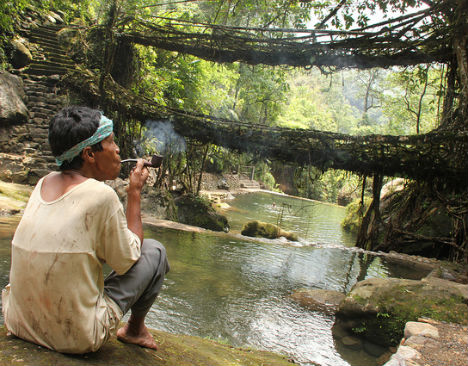
In sunny weather, the calm pools of water in Nongriat are the perfect place to bathe or relax, their waters typically shallow enough to stand in. But this peacefulness is rare, and when the rain comes – as it so often does – the locals need bridges that are stronger than steel in order to cross. Their solution? Growing their own. A native species of rubber tree is the ideal medium for living bridges that can withstand rivers that run with deadly force.

(images via: arshiya bose)

This area of Meghalaya, India gets an astonishing 49 feet of rain on average each year. Flash floods come quickly and without warning. So, long before modern engineers began designing the kinds of bridges that could hold up to such conditions, the locals here found a way around the problem.

(image via: rajkumar1220)

For 500 years, they have been manipulating the secondary roots of the ficus elastica, which grow along the length of the trunk. The roots can be bent, twisted and taught to grow in certain arrangements.

(images via: rajkumar1220)

Using hollowed-out betel nut trunks as a lightweight skeleton for the bridge, the villagers encourage the roots to grow from one side of the bank to the other, creating a platform. Because the roots are living, they won’t rot, even in the face of constant moisture.

(image via: rajkumar1220)

(image via: vinayakh)

The bridges can support the weight of up to 50 people at once, and are even built in ‘double-decker’ form. It can take decades for them to stretch across a river or farm, but they continue to grow in strength.

Wednesday, April 25, 2012

Indian Firm to Invest in Ethiopian Rubber | 2merkato.com

An Indian firm has expressed interest in a collaborative investment with Ethiopia’s government in a rubber plantation and processing industry.

The company was the only one to express interest in the joint venture following an invitation for bids by the Privatization and Public Enterprises Supervising Agency according to sources at The National Nucleus Project for a Rubber Plantation and Process Joint Venture.

PPESA is unable to disclose the identity of the company interested in the investment project because negotiations are still in the early stages according to Wondafrash Assefa, Head of Public Relations with PPESA.

The invitation was for international and domestic investors interested in a partnership or a partial rubber investment to be conducted in the West and Southwestern side of the country.

The National Nucleus Project has been in the works for the past years with a feasibility study conducted by international and domestic experts. The project is intended to supply rubber for the production of car tires.

The project was launched last year when work began on the installation of a rubber sheet processing plant at one of the rubber tree plantations areas although the project has not been fully implemented due to the large financial investment required.

In related news experts from the project visited factory sites in the largest rubber producers in the world; Côte d’Ivoire and Malaysia.

Source: Capital

Plant | Rare Plants, Plant Lovers | Plant Blog: Pruning Rubber Tree ...

Pruning rubber tree plant is one of the necessary care needed for this plant and the article will guide you with the same...

Pruning is a procedure of removal of unwanted elements of a tree to improve its growth and beauty. Landscaping usually involves pruning of trees, which includes removing dead leaves and the unproductive and unwanted parts of a tree. The reasons for pruning a tree are - maintenance, improvement of tree (fruits, flowers, leaves) and limiting the height / growth of the tree. Pruning of a tree can be done at any time but good results of pruning can be seen if pruning is done in specific season. Every plant has a different pruning period. Pruning does not lead to any harm to the tree but improper pruning may damage the plant health. Winter or spring are usually considered as suitable pruning time. Pruning is done with help of special tools which are used, depending on the size of the tree. These are called pruners.

Rubber Tree Plant
Scientific name of rubber tree plant is Ficus elastica and it is also known as India Rubber Plant. The tree belongs to the fig family. The plant has its origin in tropical countries, like, India, Malaysia and Indonesia. The plant can grow very high, about 50 feet with widespread. These plants require very less care and grow very quickly and hence are popular houseplants. They are a very good choice to get some shady corners in your rooms. These trees grow very high and hence need to be pruned when placed inside house. Let us take a look at pruning rubber tree plant.

Rubber Tree Plant Pruning
As discussed earlier, rubber tree plants grow very tall and hence need to be pruned to fit into indoors. Pruning will help to control the height of the rubber tree plant and make the plant look more beautiful. Rubber tree plants are strong and thus pruning can be done in any season. However late spring or initial summer are considered to be best seasons for pruning rubber tree plant.

Before you start pruning rubber tree plant, take a glance at the tree as you have to prune 1/3 of the tree. Ensure that you use clean, sharp and proper pruners. Wear gloves before you start pruning because the tree has white milky sap that may leak while pruning. Do not cut out too many leaves from the rubber tree plant. While pruning a rubber tree plant, see that you make cuts above the plant nodes. The plant nodes are the ones where leaves are attached to stem or where new branches grow. Rubber tree should be pruned at a height of one foot from the soil surface. New growth will be seen right below the cut you made.

Rubber Tree Plant Care Tips

  • Place them in an area with both adequate sunlight and shade.
  • Rubber tree plant should be fertilized every 15 days.
  • These trees require accurate water and need soil that drains water well.
  • The humidity level required for this plant is minimum 50%.
  • Clean the leaves regularly with the help of a damp cloth.
Pruning rubber tree plant does not damage the plant, rather it enhances its growth and improves the quality of the tree. You can give the plant a desired shape by removing unwanted leaves, branches, etc. and promote the internal growth of the rubber tree plant. Ensure that you consult an expert to guide you with proper pruning techniques.

India rubber tree cinerea » trade lead -trade site


India rubber tree, greenhouse and gray mold diseases in Spring in the South, did not start in the new red leaves when infected dead, old leaves are also large areas of rot and fall. Leaf symptoms appear as brown spots in concentric rings grow sallow wet rot and mold layer. Diseases of the Indian rubber tops dry, long. Pathogenic bacteria is gray Portugal Mortierella (BotrytiscinereaHers) is Trichosporon classes, Trichosporon projects. Description of shape and size can be found in cyclamen gray mold. India rubber tree transmission wide range of gray mold in sick deformed parasitic bacteria or soil through the winter. The greenhouse in winter, spring day and night after the larger temperature difference between the greenhouse, together with the limited space, place crowded, prone to gray mold. Improper watering, such as too much, too fast, or often susceptible to leaching temperature and leaf disease. Rot diseased shoots is not timely removed, in the leaves on susceptible. Control Method 1, the rubber tree into the winter garden greenhouse control is not too crowded after the temperature difference between day and night to prevent too large, the water should be poured separately from the basin into along, do not spray with water hose. Remove diseased leaves and leaves promptly and disease dieback disease, to reduce the infection source. 2, chemical control may refer to Phnom Penh, Lucky Bamboo gray mold control. (Such as where a)

Related posts:

  1. Botrytis cinerea control points Greenhouse Flower Gray mold disease is an important greenhouse flowers, the...
  2. Botrytis cinerea control methods marigold Disease symptoms: hazard petal, leaf and stem. When the...
  3. Control gray mold of cold studio in winter and spring leek Food Botrytis cinerea, also known as white spot disease,...
  4. Phalaenopsis concave spot The main symptoms of the disease onset, the occurrence...
  5. Disease and Pest Control Spring flowers Early spring, most of the bacteria in a dormant...

Rubber Tree: Productions of Latex and Rubber Tree Plant | Rubber

Rubber trees

Rubber trees—goosmurf (Flickr.com)

How do they produce rubber? How much rubber can they produce in a year or month?

In Western and Central Mindanao, Philippines, based on the data gathered by the government, the rubber production reached for about 395,000 tons last 2010. The rubber tree production was particularly in North Cotabato, Zamboanga Sigubay and in Basilan as well where rubber tree is abundantly planted by the Filipinos.

 Rubber tree planting is now becoming popular in many provinces in Mindanao particularly in the Central Mindanao region as evidenced by rows of rubber trees lining the roads of the areas. It has been observed that the.…

Farming Agriculture Philippines Rubber Tree Propagation Gains

Planting rubber tree is becoming more popular today especially in Central Mindanao region. You will see the rubber trees along the highway when you travel to this particular provinces.

Rubber tree is not only popular in the Philippines or Malaysia but in Cambodia as well. There are some other countries like India and Thailand that are planting rubber tree as well for business. Many businessmen or group are benefiting from the rubber trees, not only does it save a lot of money compared to any other types of businesses, but the income that you will profit from this will incredibly be big and more than you can imagine.

 Many years ago, it was too complicated to harvest the latex from the rubber trees that came from South America since the plantation was from a thick jungle. Collecting the latex was really really difficult for the tappers.

In the middle of the nineteenth century rubber came from South America where the hot wet climate suited the wild rubber tree but it was very difficult to collect it from the dense jungle. It soon became obvious that more rubber would have to be.…

Q A Rubber Cultivation in Malaysia i need some information

You better think about getting in to this type of business if you want to profit more than you can imagine.

Latex- Rubber Tree (Hevea brasiliensis) « Raxa Collective

The latex rubber tree is a tropical plant native to South America and South East Asia, which is the primary global source of natural rubber. Kerala has over 110,000 acres of land under rubber cultivation – annual production is about 690,000 tons – over 92% of India’s natural rubber.

Rubber was first planted in Kerala on an experimental scale during the 19th century in the Periyar estate of Travancore. The rubber tree is a tall softwood that grows up to thirty meters. Five years after planting, the rubber tree produces its milky latex when the bark of the tree is cut with a special knife. Rubber latex is collected and treated with formic acid to coagulate and remove the water. The rubber sheet is then smoked – after which it is used to manufacture rubber products.

Monday, April 23, 2012

India-rubber-tree

Natural rubber ยางพารา ยางพารา ยางพารา, also called Indian Rubber or caoutchouc, is an elastomer (a great elastic hydrocarbon polymer) which was originally derived from latex, a milky colloid made by some plants. The plants could be ‘tapped’, that is, an incision converted to the bark with the tree and the actual sticky, milk colored latex sap collected and refined in to a usable rubber. The purified kind of natural rubber may be the chemical polyisoprene, which can additionally be produced artificially. Natural rubber is used extensively in numerous applications and goods, as is artificial rubber. It is typically very stretchy and flexible and intensely waterproof.

The para plastic tree initially grew in South america. Charles Marie de L . a . Condamine is credited with introducing types of rubber to the actual Académie Royale des Sciences regarding France in 1736. [2] In 1751, he presented any paper by François Fresneau towards the Académie (at some point published in 1755) which described lots of the properties of plastic. This has been known as the first scientific paper on plastic. When samples regarding rubber first arrived in England, it was observed by Joseph Priestley, in 1770, that a little bit of the material was fantastic for rubbing off pencil marks in writing, hence the title rubber. Later it slowly made its way around England.

South America remained the primary source of the limited amounts of latex rubber that were used during a lot of the 19th millennium. In 1876, Henry Wickham gathered 1000s of para rubber tree seeds from Brazil, and these were germinated in Kew Backyards, England. The seedlings were then sent to Ceylon (Sri Lanka), Indonesia, Singapore and Uk Malaya. Malaya (right now Malaysia) was later to get the biggest manufacturer of rubber. About 100 in years past, the Congo Totally free State in Africa was also a substantial source of normal rubber latex, mostly gathered by forced labour. Liberia and Nigeria additionally started production regarding rubber.

In India, commercial cultivation regarding natural rubber was introduced through the British planters, although the experimental efforts to grow rubber on any commercial scale within India were initiated since 1873 at the actual Botanical Gardens, Calcutta. The first industrial Hevea plantations within India were proven at Thattekadu within Kerala in 1902. In the 19th and early the twentieth century, it was categorised as “India rubber. ” In 2010, India’s natural plastic consumption stood with 0. 978 million tons annually, with production with 0. 893 million lots; the rest was imported having an import duty regarding 20%.

Both comments and trackbacks are currently closed.

India-rubber-tree

By ~ February 9th, 2012 @ 8:11 am

Natural rubber ยางพารา ยางพารา ยางพารา, also called Of india Rubber or caoutchouc, is an elastomer (a good elastic hydrocarbon polymer) which was originally derived through latex, a milky colloid created by some plants. The plants will be ‘tapped’, that is, an incision changed to the bark of the tree and the sticky, milk colored latex sap accumulated and refined in to a usable rubber. The purified type of natural rubber could be the chemical polyisoprene, which can furthermore be produced synthetically. Natural rubber is employed extensively in many applications and items, as is synthetic rubber. It is typically very stretchy and flexible and very waterproof.

The para rubber tree initially grew in South america. Charles Marie de Los angeles Condamine is credited with introducing types of rubber to the Académie Royale des Sciences associated with France in 1736. [2] In 1751, he presented any paper by François Fresneau for the Académie (eventually published in 1755) which described most of the properties of rubber. This has been called the first technological paper on rubber. When samples associated with rubber first arrived in England, it was observed by Joseph Priestley, in 1770, that a little bit of the material was extremely good for rubbing away pencil marks in some recoverable format, hence the identify rubber. Later it slowly and gradually made its way around England.

South America remained the main source of the limited levels of latex rubber that have been used during high of the 19th millennium. In 1876, Henry Wickham gathered a large number of para rubber sapling seeds from Brazil, and these had been germinated in Kew Backyards, England. The seedlings were then provided for Ceylon (Sri Lanka), Indonesia, Singapore and English Malaya. Malaya (now Malaysia) was later to get the biggest producer of rubber. About 100 in years past, the Congo Free State in Photography equipment was also a substantial source of organic rubber latex, mostly gathered simply by forced labour. Liberia and Nigeria furthermore started production associated with rubber.

In India, commercial cultivation associated with natural rubber was introduced through the British planters, although the experimental efforts to grow rubber on any commercial scale in India were initiated as soon as 1873 at the Botanical Gardens, Calcutta. The first industrial Hevea plantations in India were set up at Thattekadu in Kerala in 1902. In the 19th and early twentieth century, it was categorised as “India rubber. ” In 2010, India’s natural rubber consumption stood at 0. 978 million tons per year, with production at 0. 893 million plenty; the rest was imported by having an import duty associated with 20%.

RSSSubscribe to blog feed.

Leave a Reply

India-rubber-tree

Some cool thailand property images:

Rubber
thailand property

Image by Joost J. Bakker IJmuiden
Rubber has several meanings including:

Natural rubber, a latex material, originally from the Para rubber tree
Latex, the sap from various plants, including the rubber tree, that is a major component in the production of natural rubber.
Latex (polymer) – A stable dispersion (emulsion) of polymer microparticles in an aqueous medium.
Elastomer, frequently used interchangeably with ‘rubber’ to describe elastic polymeric (rubbery) materials, particularly man-made rubbers
Synthetic rubber, general term for many types of man-made rubbers
Rubber, two 100-point games in contract bridge
In baseball, the rubber is the thin white slab on the pitcher’s mound from which the pitcher throws, or at times, the pitcher’s mound in general
In some sports, including tennis and cricket, an individual game in a series of matches
Rubber, a name adopted by the band Harem Scarem from 1999 – 2001
Rubber (film), a 1936 Dutch film
Rubber (Gilby Clarke album), a solo album by former Guns N’ Roses guitarist Gilby Clarke
In British English, an eraser used to remove pencil markings from paper
In British English, a slang term for galoshes (rubber boots)
In American English, Slang term for condoms
Rubber (electrical part)

Natural rubber is an elastomer (an elastic hydrocarbon polymer) that was originally derived from a milky colloidal suspension, or latex, found in the sap of some plants. The purified form of natural rubber is the chemical polyisoprene, which can also be produced synthetically. Natural rubber is used extensively in many applications and products, as is synthetic rubber

Varieties
The commercial source of natural rubber latex is the Para rubber tree (Hevea brasiliensis), a member of the spurge family, Euphorbiaceae. This is largely because it responds to wounding by producing more latex.

Other plants containing latex include Gutta-Percha (Palaquium gutta),[1] rubber fig (Ficus elastica), Panama rubber tree (Castilla elastica), spurges (Euphorbia spp.), lettuce, common dandelion (Taraxacum officinale), Russian dandelion (Taraxacum kok-saghyz), Scorzonera (tau-saghyz), and Guayule (Parthenium argentatum). Although these have not been major sources of rubber, Germany attempted to use some of these during World War II when it was cut off from rubber supplies[citation needed]. These attempts were later supplanted by the development of synthetic rubbers. To distinguish the tree-obtained version of natural rubber from the synthetic version, the term gum rubber is sometimes used.

Discovery of commercial potential
The para rubber tree initially grew in South America. Charles Marie de La Condamine is credited with introducing samples of rubber to the Académie Royale des Sciences of France in 1736. In 1751, he presented a paper by François Fresneau to the Académie (eventually published in 1755) which described many of the properties of rubber. This has been referred to as the first scientific paper on rubber.

When samples of rubber first arrived in England, it was observed by Joseph Priestley, in 1770, that a piece of the material was extremely good for obliterating pencil marks on paper, hence the name rubber.

South America remained the main source of the limited amounts of latex rubber that were used during much of the 19th century. However in 1876, Henry Wickham gathered thousands of para rubber tree seeds from Brazil, and these were germinated in Kew Gardens, England. The seedlings were then sent to Ceylon (Sri Lanka), Indonesia, Singapore and British Malaya. Malaya (now Malaysia) was later to become the biggest producer of rubber. About 100 years ago, the Congo Free State in Africa was also a significant source of natural rubber latex, mostly gathered by forced labour. Liberia and Nigeria also started production of rubber.

In India, commercial cultivation of natural rubber was introduced by the British Planters, although the experimental efforts to grow rubber on a commercial scale in India were initiated as early as 1873 at the Botanical Gardens, Calcutta. The first commercial Hevea plantations in India were established at Thattekadu in Kerala in 1902. In the 19th and early 20th century, it was often called "India rubber."

[edit] Properties

Rubber latexRubber exhibits unique physical and chemical properties. Rubber’s stress-strain behavior exhibits the Mullins effect, the Payne effect, and is often modeled as hyperelastic. Rubber strain crystallizes.

Owing to the presence of a double bond in each repeat unit, natural rubber is sensitive to ozone cracking.

[edit] Solvents
There are two main solvents for rubber: turpentine and naphtha (petroleum). The former has been in use since 1763 when François Fresnau made the discovery. Giovanni Fabronni is credited with the discovery of naphtha as a rubber solvent in 1779. Because rubber does not dissolve easily, the material is finely divided by shredding prior to its immersion.

An ammonia solution can be used to prevent the coagulation of raw latex while it is being transported from its collection site.

Chemical makeup
Latex is a natural polymer of isoprene (most often cis-1,4-polyisoprene) – with a molecular weight of 100,000 to 1,000,000. Typically, a small percent (up to 5% of dry mass) of other materials, such as proteins, fatty acids, resins and inorganic materials (salts) are found in natural rubber. Polyisoprene is also created synthetically, producing what is sometimes referred to as "synthetic natural rubber".

Some natural rubber sources called gutta percha are composed of trans-1,4-polyisoprene, a structural isomer which has similar, but not identical, properties.

Natural rubber is an elastomer and a thermoplastic. However, it should be noted that as the rubber is vulcanized, it will turn into a thermoset. Most rubber in everyday use is vulcanized to a point where it shares properties of both; i.e., if it is heated and cooled, it is degraded but not destroyed.

Elasticity
In most elastic materials, such as metals used in springs, the elastic behavior is caused by bond distortions. When force is applied, bond lengths deviate from the (minimum energy) equilibrium and strain energy is stored electrostatically. Rubber is often assumed to behave in the same way, but it turns out this is a poor description. Rubber is a curious material because, unlike metals, strain energy is stored thermally. Also, natural rubber is so elastic that when force is applied, on natural rubber when it is on a surface similar to carpet, it may be difficult to ‘pull’ across the surface. It will stick.

In its relaxed state, rubber consists of long, coiled-up polymer chains that are interlinked at a few points. Between a pair of links, each monomer can rotate freely about its neighbour, thus giving each section of chain leeway to assume a large number of geometries, like a very loose rope attached to a pair of fixed points. At room temperature, rubber stores enough kinetic energy so that each section of chain oscillates chaotically, like the above piece of rope being shaken violently. The entropy model of rubber was developed in 1934 by Werner Kuhn.

When rubber is stretched, the "loose pieces of rope" are taut and thus no longer able to oscillate. Their kinetic energy is given off as excess heat. Therefore, the entropy decreases when going from the relaxed to the stretched state, and it increases during relaxation. This change in entropy can also be explained by the fact that a tight section of chain can fold in fewer ways (W) than a loose section of chain, at a given temperature (nb. entropy is defined as S=k*ln(W)). Relaxation of a stretched rubber band is thus driven by an increase in entropy, and the force experienced is not electrostatic, rather it is a result of the thermal energy of the material being converted to kinetic energy. Rubber relaxation is endothermic, and for this reason the force exerted by a stretched piece of rubber increases with temperature (Metals, for example, become softer as temperature increases). The material undergoes adiabatic cooling during contraction. This property of rubber can easily be verified by holding a stretched rubber band to your lips and relaxing it. Stretching of a rubber band is in some ways equivalent to the compression of an ideal gas, and relaxation is equivalent to its expansion. Note that a compressed gas also exhibits "elastic" properties, for instance inside an inflated car tire. The fact that stretching is equivalent to compression may seem somewhat counter-intuitive, but it makes sense if rubber is viewed as a one-dimensional gas. Stretching reduces the "space" available to each section of chain.

Vulcanization of rubber creates more disulfide bonds between chains, so it shortens each free section of chain. The result is that the chains tighten more quickly for a given length of strain, thereby increasing the elastic force constant and making rubber harder and less extendable.

When cooled below the glass transition temperature, the quasi-fluid chain segments "freeze" into fixed geometries and the rubber abruptly loses its elastic properties, although the process is reversible. This is a property it shares with most elastomers. At very cold temperatures, rubber is actually rather brittle; it will break into shards when struck or stretched. This critical temperature is the reason that winter tires use a softer version of rubber than normal tires. The failing rubber o-ring seals that contributed to the cause of the Challenger disaster were thought to have cooled below their critical temperature. The disaster happened on an unusually cold day.

Current sources
Close to 21 million tons of rubber were produced in 2005 of which around 42% was natural. Since the bulk of the rubber produced is the synthetic variety which is derived from petroleum, the price of even natural rubber is determined to a very large extent by the prevailing global price of crude oil.[citation needed] Today Asia is the main source of natural rubber, accounting for around 94% of output in 2005. The three largest producing countries (Indonesia, Malaysia and Thailand) together account for around 72% of all natural rubber production

Cultivation
Rubber latex is extracted from Rubber trees. The economic life period of rubber trees in plantations is around 32 years – up to 7 years of immature phase and about 25 years of productive phase.

The soil requirement of the plant is generally well-drained weathered soil consisting of laterite, lateritic types, sedimentary types, nonlateritic red or alluvial soils.

The climatic conditions for optimum growth of Rubber trees consist of (a) Rainfall of around 250 cm evenly distributed without any marked dry season and with at least 100 rainy days per annum (b) Temperature range of about 20°C to 34°C with a monthly mean of 25°C to 28°C (c) High atmospheric humidity of around 80% (d) Bright sunshine amounting to about 2000 hours per annum at the rate of 6 hours per day throughout the year and (e) Absence of strong winds.

Many high-yielding clones have been developed for commercial planting. These clones yield more than 2,000 kilograms of dry Rubber per hectare per annum, when grown under ideal conditions.
Collection

In places like Kerala, where coconuts are in abundance, the half shell of coconut is used as the collection container for the latex but glazed pottery or aluminium or plastic cups are more common elsewhere. The cups are supported by a wire that encircles the tree.This wire incorporates a spring so that it can stretch as the tree grows. The latex is led into the cup by a galvanised "spout" that has been knocked into the bark. Tapping normally takes place early in the morning when the internal pressure of the tree is highest. A good tapper can tap a tree every 20 seconds on a standard half-spiral system and a common daily "task" size is between 450 and 650 trees. Trees are usually tapped alternate or third daily although there are many variations in timing, length and number of cuts. The latex, which contains 25 – 40% dry rubber, is in the bark so the tapper must avoid cutting right through to the wood or the growing cambial layer will be damaged and the renewing bark will be badly deformed making later tapping difficult. It is usual to tap a pannel at least twice, sometimes three times, during the trees’ life. The economic life of the tree depends on how well the tapping is carried out as the critical factor is bark consumption. A standard in Malaysia for alternate daily tapping is 25 cm (vertical) bark consumption per annum. The latex tubes in the bark ascend in a spiral to the right. For this reason, tapping cuts usually ascend to the left to cut more tubes.

The trees will drip latex for about four hours, stopping as latex coagulates naturally on the tapping cut thus blocking the latex tubes in the bark. Tappers usually rest and have a meal after finishing their tapping work then start collecting the latex at about midday. Some trees will continue to drip after the collection and this leads to a small amount of cup lump which is collected at the next tapping. The latex that coagulates on the cut is also collected as tree lace. Tree lace and cup lump together account for 10 – 20% of the dry rubber produced.

The latex will coagulate in cup if kept for long. The latex has to be collected before coagulation. The collected latex is transffered in to coagulation tanks for the preparation of dry rubber or transferred into air tight containers with sieving for ammoniation. Ammoniation is necessary to preserve the latex in colloidal state for long.

Latex is generally processed into either latex concentrate for manufacture of dipped goods or it can be coagulated under controlled, clean conditions using formic acid. The coagulated latex can then be processed into the higher grade technically specified block rubbers such as TSR3L or TSRCV or used to produce Ribbed Smoke Sheet grades.

Naturally coagulated rubber (cup lump) is used in the manufacture of TSR10 and TSR20 grade rubbers. The processing of the rubber for these grades is basically a size reduction and cleaning process in order to remove contamination and prepare the material for the final stage drying.

The dried material is then baled and palletized for shipment.

Uses
The use of rubber is widespread, ranging from household to industrial products, entering the production stream at the intermediate stage or as final products. Tires and tubes are the largest consumers of rubber. The remaining 44% are taken up by the general rubber goods (GRG) sector, which includes all products except tires and tubes.

Pre-historical uses
The first use of rubber was by the Olmecs, centuries later passed on the knowledge of natural latex from the Hevea Tree in 1600 BC to the Ancient Mayans.[citation needed] They boiled the harvested latex to make a ball for sport.[citation needed]

Manufacturing
Other significant uses of rubber are door and window profiles, hoses, belts, matting, flooring and dampeners (anti-vibration mounts) for the automotive industry in what is known as the "under the bonnet" products. Gloves (medical, household and industrial) and toy balloons are also large consumers of rubber, although the type of rubber used is that of the concentrated latex. Significant tonnage of rubber is used as adhesives in many manufacturing industries and products, although the two most noticeable are the paper and the carpet industry. Rubber is also commonly used to make rubber bands and pencil erasers.

Textile applications
Additionally, rubber produced as a fiber sometimes called elastic, has significant value for use in the textile industry because of its excellent elongation and recovery properties. For these purposes, manufactured rubber fiber is made as either an extruded round fiber or rectangular fibers that are cut into strips from extruded film. Because of its low dye acceptance, feel and appearance, the rubber fiber is either covered by yarn of another fiber or directly woven with other yarns into the fabric. In the early 1900s, for example, rubber yarns were used in foundation garments. While rubber is still used in textile manufacturing, its low tenacity limits its use in lightweight garments because latex lacks resistance to oxidizing agents and is damaged by aging, sunlight, oil, and perspiration. Seeking a way to address these shortcomings, the textile industry has turned to Neoprene (polymer form of Chloroprene), a type of synthetic rubber as well as another more commonly used elastomer fiber, spandex (also known as elastane), because of their superiority to rubber in both strength and durability.

Vulcanization
Main article: Vulcanization
Natural rubber is often vulcanized, a process by which the rubber is heated and sulfur, peroxide or bisphenol are added to improve resilience and elasticity, and to prevent it from perishing. Vulcanization greatly improved the durability and utility of rubber from the 1830s on.[citation needed] The development of vulcanization is most closely associated with Charles Goodyear in 1839.[3] Carbon black is often used as an additive to rubber to improve its strength, especially in vehicle tires.

Allergic reactions
Main article: Latex allergy
Some people have a serious latex allergy, and exposure to certain natural rubber latex products such as latex gloves can cause anaphylactic shock. Guayule latex is hypoallergenic and is being researched as a substitute to the allergy-inducing Hevea latexes. Unlike the sappable Hevea tree, these relatively small shrubs must be harvested whole and latex extracted from each cell. Chemical processes may also be employed to reduce the amount of antigenic protein in Hevea latex, resulting in alternative Hevea-based materials such Vytex Natural Rubber Latex that, while not completely hypoallergenic, do provide lessened exposure to latex allergens.

Some allergic reactions are not from the latex but from residues of other ingredients used to process the latex into clothing, gloves, foam, etc. These allergies are usually referred to as multiple chemical sensitivity (MCS).

rubber
thailand property

Image by Joost J. Bakker IJmuiden
Rubber has several meanings including:

Natural rubber, a latex material, originally from the Para rubber tree
Latex, the sap from various plants, including the rubber tree, that is a major component in the production of natural rubber.
Latex (polymer) – A stable dispersion (emulsion) of polymer microparticles in an aqueous medium.
Elastomer, frequently used interchangeably with ‘rubber’ to describe elastic polymeric (rubbery) materials, particularly man-made rubbers
Synthetic rubber, general term for many types of man-made rubbers
Rubber, two 100-point games in contract bridge
In baseball, the rubber is the thin white slab on the pitcher’s mound from which the pitcher throws, or at times, the pitcher’s mound in general
In some sports, including tennis and cricket, an individual game in a series of matches
Rubber, a name adopted by the band Harem Scarem from 1999 – 2001
Rubber (film), a 1936 Dutch film
Rubber (Gilby Clarke album), a solo album by former Guns N’ Roses guitarist Gilby Clarke
In British English, an eraser used to remove pencil markings from paper
In British English, a slang term for galoshes (rubber boots)
In American English, Slang term for condoms
Rubber (electrical part)

Natural rubber is an elastomer (an elastic hydrocarbon polymer) that was originally derived from a milky colloidal suspension, or latex, found in the sap of some plants. The purified form of natural rubber is the chemical polyisoprene, which can also be produced synthetically. Natural rubber is used extensively in many applications and products, as is synthetic rubber

Varieties
The commercial source of natural rubber latex is the Para rubber tree (Hevea brasiliensis), a member of the spurge family, Euphorbiaceae. This is largely because it responds to wounding by producing more latex.

Other plants containing latex include Gutta-Percha (Palaquium gutta),[1] rubber fig (Ficus elastica), Panama rubber tree (Castilla elastica), spurges (Euphorbia spp.), lettuce, common dandelion (Taraxacum officinale), Russian dandelion (Taraxacum kok-saghyz), Scorzonera (tau-saghyz), and Guayule (Parthenium argentatum). Although these have not been major sources of rubber, Germany attempted to use some of these during World War II when it was cut off from rubber supplies[citation needed]. These attempts were later supplanted by the development of synthetic rubbers. To distinguish the tree-obtained version of natural rubber from the synthetic version, the term gum rubber is sometimes used.

Discovery of commercial potential
The para rubber tree initially grew in South America. Charles Marie de La Condamine is credited with introducing samples of rubber to the Académie Royale des Sciences of France in 1736. In 1751, he presented a paper by François Fresneau to the Académie (eventually published in 1755) which described many of the properties of rubber. This has been referred to as the first scientific paper on rubber.

When samples of rubber first arrived in England, it was observed by Joseph Priestley, in 1770, that a piece of the material was extremely good for obliterating pencil marks on paper, hence the name rubber.

South America remained the main source of the limited amounts of latex rubber that were used during much of the 19th century. However in 1876, Henry Wickham gathered thousands of para rubber tree seeds from Brazil, and these were germinated in Kew Gardens, England. The seedlings were then sent to Ceylon (Sri Lanka), Indonesia, Singapore and British Malaya. Malaya (now Malaysia) was later to become the biggest producer of rubber. About 100 years ago, the Congo Free State in Africa was also a significant source of natural rubber latex, mostly gathered by forced labour. Liberia and Nigeria also started production of rubber.

In India, commercial cultivation of natural rubber was introduced by the British Planters, although the experimental efforts to grow rubber on a commercial scale in India were initiated as early as 1873 at the Botanical Gardens, Calcutta. The first commercial Hevea plantations in India were established at Thattekadu in Kerala in 1902. In the 19th and early 20th century, it was often called "India rubber."

[edit] Properties

Rubber latexRubber exhibits unique physical and chemical properties. Rubber’s stress-strain behavior exhibits the Mullins effect, the Payne effect, and is often modeled as hyperelastic. Rubber strain crystallizes.

Owing to the presence of a double bond in each repeat unit, natural rubber is sensitive to ozone cracking.

[edit] Solvents
There are two main solvents for rubber: turpentine and naphtha (petroleum). The former has been in use since 1763 when François Fresnau made the discovery. Giovanni Fabronni is credited with the discovery of naphtha as a rubber solvent in 1779. Because rubber does not dissolve easily, the material is finely divided by shredding prior to its immersion.

An ammonia solution can be used to prevent the coagulation of raw latex while it is being transported from its collection site.

Chemical makeup
Latex is a natural polymer of isoprene (most often cis-1,4-polyisoprene) – with a molecular weight of 100,000 to 1,000,000. Typically, a small percent (up to 5% of dry mass) of other materials, such as proteins, fatty acids, resins and inorganic materials (salts) are found in natural rubber. Polyisoprene is also created synthetically, producing what is sometimes referred to as "synthetic natural rubber".

Some natural rubber sources called gutta percha are composed of trans-1,4-polyisoprene, a structural isomer which has similar, but not identical, properties.

Natural rubber is an elastomer and a thermoplastic. However, it should be noted that as the rubber is vulcanized, it will turn into a thermoset. Most rubber in everyday use is vulcanized to a point where it shares properties of both; i.e., if it is heated and cooled, it is degraded but not destroyed.

Elasticity
In most elastic materials, such as metals used in springs, the elastic behavior is caused by bond distortions. When force is applied, bond lengths deviate from the (minimum energy) equilibrium and strain energy is stored electrostatically. Rubber is often assumed to behave in the same way, but it turns out this is a poor description. Rubber is a curious material because, unlike metals, strain energy is stored thermally. Also, natural rubber is so elastic that when force is applied, on natural rubber when it is on a surface similar to carpet, it may be difficult to ‘pull’ across the surface. It will stick.

In its relaxed state, rubber consists of long, coiled-up polymer chains that are interlinked at a few points. Between a pair of links, each monomer can rotate freely about its neighbour, thus giving each section of chain leeway to assume a large number of geometries, like a very loose rope attached to a pair of fixed points. At room temperature, rubber stores enough kinetic energy so that each section of chain oscillates chaotically, like the above piece of rope being shaken violently. The entropy model of rubber was developed in 1934 by Werner Kuhn.

When rubber is stretched, the "loose pieces of rope" are taut and thus no longer able to oscillate. Their kinetic energy is given off as excess heat. Therefore, the entropy decreases when going from the relaxed to the stretched state, and it increases during relaxation. This change in entropy can also be explained by the fact that a tight section of chain can fold in fewer ways (W) than a loose section of chain, at a given temperature (nb. entropy is defined as S=k*ln(W)). Relaxation of a stretched rubber band is thus driven by an increase in entropy, and the force experienced is not electrostatic, rather it is a result of the thermal energy of the material being converted to kinetic energy. Rubber relaxation is endothermic, and for this reason the force exerted by a stretched piece of rubber increases with temperature (Metals, for example, become softer as temperature increases). The material undergoes adiabatic cooling during contraction. This property of rubber can easily be verified by holding a stretched rubber band to your lips and relaxing it. Stretching of a rubber band is in some ways equivalent to the compression of an ideal gas, and relaxation is equivalent to its expansion. Note that a compressed gas also exhibits "elastic" properties, for instance inside an inflated car tire. The fact that stretching is equivalent to compression may seem somewhat counter-intuitive, but it makes sense if rubber is viewed as a one-dimensional gas. Stretching reduces the "space" available to each section of chain.

Vulcanization of rubber creates more disulfide bonds between chains, so it shortens each free section of chain. The result is that the chains tighten more quickly for a given length of strain, thereby increasing the elastic force constant and making rubber harder and less extendable.

When cooled below the glass transition temperature, the quasi-fluid chain segments "freeze" into fixed geometries and the rubber abruptly loses its elastic properties, although the process is reversible. This is a property it shares with most elastomers. At very cold temperatures, rubber is actually rather brittle; it will break into shards when struck or stretched. This critical temperature is the reason that winter tires use a softer version of rubber than normal tires. The failing rubber o-ring seals that contributed to the cause of the Challenger disaster were thought to have cooled below their critical temperature. The disaster happened on an unusually cold day.

Current sources
Close to 21 million tons of rubber were produced in 2005 of which around 42% was natural. Since the bulk of the rubber produced is the synthetic variety which is derived from petroleum, the price of even natural rubber is determined to a very large extent by the prevailing global price of crude oil.[citation needed] Today Asia is the main source of natural rubber, accounting for around 94% of output in 2005. The three largest producing countries (Indonesia, Malaysia and Thailand) together account for around 72% of all natural rubber production

Cultivation
Rubber latex is extracted from Rubber trees. The economic life period of rubber trees in plantations is around 32 years – up to 7 years of immature phase and about 25 years of productive phase.

The soil requirement of the plant is generally well-drained weathered soil consisting of laterite, lateritic types, sedimentary types, nonlateritic red or alluvial soils.

The climatic conditions for optimum growth of Rubber trees consist of (a) Rainfall of around 250 cm evenly distributed without any marked dry season and with at least 100 rainy days per annum (b) Temperature range of about 20°C to 34°C with a monthly mean of 25°C to 28°C (c) High atmospheric humidity of around 80% (d) Bright sunshine amounting to about 2000 hours per annum at the rate of 6 hours per day throughout the year and (e) Absence of strong winds.

Many high-yielding clones have been developed for commercial planting. These clones yield more than 2,000 kilograms of dry Rubber per hectare per annum, when grown under ideal conditions.
Collection

In places like Kerala, where coconuts are in abundance, the half shell of coconut is used as the collection container for the latex but glazed pottery or aluminium or plastic cups are more common elsewhere. The cups are supported by a wire that encircles the tree.This wire incorporates a spring so that it can stretch as the tree grows. The latex is led into the cup by a galvanised "spout" that has been knocked into the bark. Tapping normally takes place early in the morning when the internal pressure of the tree is highest. A good tapper can tap a tree every 20 seconds on a standard half-spiral system and a common daily "task" size is between 450 and 650 trees. Trees are usually tapped alternate or third daily although there are many variations in timing, length and number of cuts. The latex, which contains 25 – 40% dry rubber, is in the bark so the tapper must avoid cutting right through to the wood or the growing cambial layer will be damaged and the renewing bark will be badly deformed making later tapping difficult. It is usual to tap a pannel at least twice, sometimes three times, during the trees’ life. The economic life of the tree depends on how well the tapping is carried out as the critical factor is bark consumption. A standard in Malaysia for alternate daily tapping is 25 cm (vertical) bark consumption per annum. The latex tubes in the bark ascend in a spiral to the right. For this reason, tapping cuts usually ascend to the left to cut more tubes.

The trees will drip latex for about four hours, stopping as latex coagulates naturally on the tapping cut thus blocking the latex tubes in the bark. Tappers usually rest and have a meal after finishing their tapping work then start collecting the latex at about midday. Some trees will continue to drip after the collection and this leads to a small amount of cup lump which is collected at the next tapping. The latex that coagulates on the cut is also collected as tree lace. Tree lace and cup lump together account for 10 – 20% of the dry rubber produced.

The latex will coagulate in cup if kept for long. The latex has to be collected before coagulation. The collected latex is transffered in to coagulation tanks for the preparation of dry rubber or transferred into air tight containers with sieving for ammoniation. Ammoniation is necessary to preserve the latex in colloidal state for long.

Latex is generally processed into either latex concentrate for manufacture of dipped goods or it can be coagulated under controlled, clean conditions using formic acid. The coagulated latex can then be processed into the higher grade technically specified block rubbers such as TSR3L or TSRCV or used to produce Ribbed Smoke Sheet grades.

Naturally coagulated rubber (cup lump) is used in the manufacture of TSR10 and TSR20 grade rubbers. The processing of the rubber for these grades is basically a size reduction and cleaning process in order to remove contamination and prepare the material for the final stage drying.

The dried material is then baled and palletized for shipment.

Uses
The use of rubber is widespread, ranging from household to industrial products, entering the production stream at the intermediate stage or as final products. Tires and tubes are the largest consumers of rubber. The remaining 44% are taken up by the general rubber goods (GRG) sector, which includes all products except tires and tubes.

Pre-historical uses
The first use of rubber was by the Olmecs, centuries later passed on the knowledge of natural latex from the Hevea Tree in 1600 BC to the Ancient Mayans.[citation needed] They boiled the harvested latex to make a ball for sport.[citation needed]

Manufacturing
Other significant uses of rubber are door and window profiles, hoses, belts, matting, flooring and dampeners (anti-vibration mounts) for the automotive industry in what is known as the "under the bonnet" products. Gloves (medical, household and industrial) and toy balloons are also large consumers of rubber, although the type of rubber used is that of the concentrated latex. Significant tonnage of rubber is used as adhesives in many manufacturing industries and products, although the two most noticeable are the paper and the carpet industry. Rubber is also commonly used to make rubber bands and pencil erasers.

Textile applications
Additionally, rubber produced as a fiber sometimes called elastic, has significant value for use in the textile industry because of its excellent elongation and recovery properties. For these purposes, manufactured rubber fiber is made as either an extruded round fiber or rectangular fibers that are cut into strips from extruded film. Because of its low dye acceptance, feel and appearance, the rubber fiber is either covered by yarn of another fiber or directly woven with other yarns into the fabric. In the early 1900s, for example, rubber yarns were used in foundation garments. While rubber is still used in textile manufacturing, its low tenacity limits its use in lightweight garments because latex lacks resistance to oxidizing agents and is damaged by aging, sunlight, oil, and perspiration. Seeking a way to address these shortcomings, the textile industry has turned to Neoprene (polymer form of Chloroprene), a type of synthetic rubber as well as another more commonly used elastomer fiber, spandex (also known as elastane), because of their superiority to rubber in both strength and durability.

Vulcanization
Main article: Vulcanization
Natural rubber is often vulcanized, a process by which the rubber is heated and sulfur, peroxide or bisphenol are added to improve resilience and elasticity, and to prevent it from perishing. Vulcanization greatly improved the durability and utility of rubber from the 1830s on.[citation needed] The development of vulcanization is most closely associated with Charles Goodyear in 1839.[3] Carbon black is often used as an additive to rubber to improve its strength, especially in vehicle tires.

Allergic reactions
Main article: Latex allergy
Some people have a serious latex allergy, and exposure to certain natural rubber latex products such as latex gloves can cause anaphylactic shock. Guayule latex is hypoallergenic and is being researched as a substitute to the allergy-inducing Hevea latexes. Unlike the sappable Hevea tree, these relatively small shrubs must be harvested whole and latex extracted from each cell. Chemical processes may also be employed to reduce the amount of antigenic protein in Hevea latex, resulting in alternative Hevea-based materials such Vytex Natural Rubber Latex that, while not completely hypoallergenic, do provide lessened exposure to latex allergens.

Some allergic reactions are not from the latex but from residues of other ingredients used to process the latex into clothing, gloves, foam, etc. These allergies are usually referred to as multiple chemical sensitivity (MCS).

Friday, April 20, 2012

India-rubber-tree

Natural rubber ยางพารา ยางพารา ยางพารา, also called Indian Rubber or caoutchouc, is an elastomer (a great elastic hydrocarbon polymer) which was originally derived from latex, a milky colloid made by some plants. The plants could be ‘tapped’, that is, an incision converted to the bark with the tree and the actual sticky, milk colored latex sap collected and refined in to a usable rubber. The purified kind of natural rubber may be the chemical polyisoprene, which can additionally be produced artificially. Natural rubber is used extensively in numerous applications and goods, as is artificial rubber. It is typically very stretchy and flexible and intensely waterproof.

The para plastic tree initially grew in South america. Charles Marie de L . a . Condamine is credited with introducing types of rubber to the actual Académie Royale des Sciences regarding France in 1736. [2] In 1751, he presented any paper by François Fresneau towards the Académie (at some point published in 1755) which described lots of the properties of plastic. This has been known as the first scientific paper on plastic. When samples regarding rubber first arrived in England, it was observed by Joseph Priestley, in 1770, that a little bit of the material was fantastic for rubbing off pencil marks in writing, hence the title rubber. Later it slowly made its way around England.

South America remained the primary source of the limited amounts of latex rubber that were used during a lot of the 19th millennium. In 1876, Henry Wickham gathered 1000s of para rubber tree seeds from Brazil, and these were germinated in Kew Backyards, England. The seedlings were then sent to Ceylon (Sri Lanka), Indonesia, Singapore and Uk Malaya. Malaya (right now Malaysia) was later to get the biggest manufacturer of rubber. About 100 in years past, the Congo Totally free State in Africa was also a substantial source of normal rubber latex, mostly gathered by forced labour. Liberia and Nigeria additionally started production regarding rubber.

In India, commercial cultivation regarding natural rubber was introduced through the British planters, although the experimental efforts to grow rubber on any commercial scale within India were initiated since 1873 at the actual Botanical Gardens, Calcutta. The first industrial Hevea plantations within India were proven at Thattekadu within Kerala in 1902. In the 19th and early the twentieth century, it was categorised as “India rubber. ” In 2010, India’s natural plastic consumption stood with 0. 978 million tons annually, with production with 0. 893 million lots; the rest was imported having an import duty regarding 20%.

Both comments and trackbacks are currently closed.

India-rubber-tree

From car tyres to humble rubber-bands used for domestic purposes, rubber is an essential resource in today’s world. Natural rubber is obtained from the Hevea Brasiliensis tree, more commonly known as the rubber tree. Rubber trees though found in many parts of the world, grow best in the South Asian humid climate. Countries such as Thailand, Vietnam, India, Sri Lanka, Singapore to name a few, are some of the largest producers of natural rubber and meet more than 90 percent of the world's rubber requirements.

The price of natural rubber has witnessed a tremendous hike in recent years and is now almost three times the price it used to be per kilo. Lower supplies due to bad crops have led to this, and with little expectations of the supply of natural rubber increasing in the near future, rubber prices are slated to remain high. Regional currencies that have grown stronger against the US Dollar have also contributed to the increase in prices of natural rubber.

The hike in rubber prices affects all industries dependent on it and in particular the tyre industry. The cost of natural rubber accounts for nearly 40 percent of the cost of a tyre. A hike in rubber prices naturally cuts deep into the profits of tyre companies. While all companies aim to keep their costs competitive, most have passed on the additional burden to the buyers. Almost all tyre companies in India have been forced to increase the cost of their tyres with some such as Michelin having to revise their prices twice in two months.

The Indian tyre industry is expected to grow with the large scale development of infrastructure in India. Some of the world's leading tyre manufacturers such as Michelin, Bridgestone and Continental have set up manufacturing plants on Indian soil in order to maximize their profits and capture the Indian tyre industry. Tyre companies, both Indian and foreign, have invested Crores of rupees to set up new factories or revamp existing ones to gear up for the demands of the automobile and tyre markets. In the wake of high rubber prices, tyre companies face an additional pressure on the profit margins due to increased debt and higher interest rates.  

Low cost tyre imports from China compound the worries of Indian tyre manufacturers as they stand to lose a substantial share of the market. The Government of India provided some respite to tyre companies by allowing subsidies on 40,000 tonnes of natural rubber import. While the Government is trying to protect the interest of the domestic rubber industry, the onus lies with tyre manufacturers to restructure their modus operandi in order to sustain the profit margins.     

The demand for tyres in India, especially for radial tyres for commercial vehicles is set to increase regardless of higher natural rubber prices. It is up to the tyre manufacturing companies in India to manage the cost pressures imposed and be able to competitively price their products after passing on the increased input costs to the customer in order to sustain margins and retain profitability.  

India-rubber-tree

By ~ February 9th, 2012 @ 8:11 am

Natural rubber ยางพารา ยางพารา ยางพารา, also called Of india Rubber or caoutchouc, is an elastomer (a good elastic hydrocarbon polymer) which was originally derived through latex, a milky colloid created by some plants. The plants will be ‘tapped’, that is, an incision changed to the bark of the tree and the sticky, milk colored latex sap accumulated and refined in to a usable rubber. The purified type of natural rubber could be the chemical polyisoprene, which can furthermore be produced synthetically. Natural rubber is employed extensively in many applications and items, as is synthetic rubber. It is typically very stretchy and flexible and very waterproof.

The para rubber tree initially grew in South america. Charles Marie de Los angeles Condamine is credited with introducing types of rubber to the Académie Royale des Sciences associated with France in 1736. [2] In 1751, he presented any paper by François Fresneau for the Académie (eventually published in 1755) which described most of the properties of rubber. This has been called the first technological paper on rubber. When samples associated with rubber first arrived in England, it was observed by Joseph Priestley, in 1770, that a little bit of the material was extremely good for rubbing away pencil marks in some recoverable format, hence the identify rubber. Later it slowly and gradually made its way around England.

South America remained the main source of the limited levels of latex rubber that have been used during high of the 19th millennium. In 1876, Henry Wickham gathered a large number of para rubber sapling seeds from Brazil, and these had been germinated in Kew Backyards, England. The seedlings were then provided for Ceylon (Sri Lanka), Indonesia, Singapore and English Malaya. Malaya (now Malaysia) was later to get the biggest producer of rubber. About 100 in years past, the Congo Free State in Photography equipment was also a substantial source of organic rubber latex, mostly gathered simply by forced labour. Liberia and Nigeria furthermore started production associated with rubber.

In India, commercial cultivation associated with natural rubber was introduced through the British planters, although the experimental efforts to grow rubber on any commercial scale in India were initiated as soon as 1873 at the Botanical Gardens, Calcutta. The first industrial Hevea plantations in India were set up at Thattekadu in Kerala in 1902. In the 19th and early twentieth century, it was categorised as “India rubber. ” In 2010, India’s natural rubber consumption stood at 0. 978 million tons per year, with production at 0. 893 million plenty; the rest was imported by having an import duty associated with 20%.

RSSSubscribe to blog feed.

Leave a Reply

Monday, April 16, 2012

This14U: All you need to know about rubber


The word “rubber” had a lively existence long before it became attached to the elastic substance we associate it with today.

.
A “rubber” could be a hard brush (1664), 
.
A rough towel to stimulate the skin (1577), 
.
A horse towel (1598)
.
A whetstone (1553)
.
Tooth powder (1558)
.
A polished brick (1744)
.
A person who takes brass rubbings (1840) 
.
And a masseur at a Turkish bath.
.
Erasing rubber


When samples of the dried sap of a South American tree began arriving in England in the late 18th century, they were soon being stocked in half-inch cubes in Edward Nairne’s scientific instrument shop at 20 Cornhill in London. 
.
Nairne claimed that while drawing he had picked up a piece of the substance instead of the breadcrumb that was traditionally used to erase pencil marks. 
.
The cube of sap proved more effective.
.
The discoverer of oxygen and inventor of soda water, Joseph Priestley (1733-1804), was an early customer, paying a hefty three shillings (£17 in today’s money) for a single cube.
.
India rubber


This substance became known as “India rubber”, although it came from South America rather than India (“Indian” just meant something exotic from abroad; Indian ink was actually from China). 
.
The rubber had found its way from Brazil to Europe via the French.
.
In 1735, poet, mathematician and friend of Voltaire, Charles Marie de la Condamine, sent a sample back to the Académie Royale enclosing the local Indian word for the material, caoutchouc, and for the tree it came from, heve. 
.
La Condamine also coined the term latex for the white sap, from the French word for “milk”.
.
Rubbery plants


The rubber tree isn’t the only plant with rubbery sap, but it is the only one that produces more latex each time it is cut. 
.
The wound stimulates its rate of photosynthesis, giving each tree a productive life of up to 35 years.
.
It’s a large woody member of the Euphorbia family, which boasts over 7,500 species, many of them known as spurges, and almost all of them producing milky sap. 
.
The name “spurge” comes from the old French word espurgier – meaning “to purge”, because the plants were used as laxatives.
.
Euphorbia itself comes from the name Euphorbus, the physician to Juba II, a Roman client king in North Africa during the time of Augustus. 
.
Euphorbus effected a cure by feeding the king a spurge and Juba was so impressed he named the plant after him. 
.
It means, literally, “well-fed”.
.
Other high-profile members of the spurge family include cassava, the castor-oil plant and that Christmas favourite, the poinsettia.
.
Stolen rubber


.
Roughly 40 per cent of the rubber used today is from natural sources and of that
.
94 per cent comes from south-east Asia.
.
This is partly because the rubber tree is difficult to cultivate in South America (it quickly falls prey to blight), and partly through the audacious scam of a British entrepreneur called Henry Wickham (1846-1928). 
.
Wickham collected rubber tree seeds from the Brazilian jungle (70,000 according to his own unreliable account) and smuggled them back to the Botanical Gardens at Kew. 
.
Although fewer than four per cent germinated, this was enough to establish the British rubber plantations in south-east Asia.
.
Wickham was a fantasist and a terrible businessman. 
.
His attempts to establish farms in the wilds of Brazil and the Pacific were miserable failures.
.
Nevertheless, he was eventually knighted and is still acclaimed as the “father of commercial rubber planting”.
.
Rubber boots

Arthur Wellesley, 1st Duke of Wellington, pioneered a new version of the slightly pointed, low-heeled, mid-calf short cavalry boot known as the Hessian boot (the style was popular with German officers from the Hesse region). 
.
Wellington extended it upwards to protect the knee. 
.
In 1853, the American businessman Hiram Hutchinson stole this popular style for his new rubber boot factory in France, called A l’Aigle (“To the Eagle”, in honour of the United States: and now just Aigle), and the rubber Wellington boot was born. 
.
It was an immediate hit with people working on the land.
.
So, a short history of the welly: designed by Germans, named by an Irishman, manufactured by an American and first worn by soggy-footed French peasants.

India-rubber-tree

Some cool thailand property images:

Rubber
thailand property

Image by Joost J. Bakker IJmuiden
Rubber has several meanings including:

Natural rubber, a latex material, originally from the Para rubber tree
Latex, the sap from various plants, including the rubber tree, that is a major component in the production of natural rubber.
Latex (polymer) – A stable dispersion (emulsion) of polymer microparticles in an aqueous medium.
Elastomer, frequently used interchangeably with ‘rubber’ to describe elastic polymeric (rubbery) materials, particularly man-made rubbers
Synthetic rubber, general term for many types of man-made rubbers
Rubber, two 100-point games in contract bridge
In baseball, the rubber is the thin white slab on the pitcher’s mound from which the pitcher throws, or at times, the pitcher’s mound in general
In some sports, including tennis and cricket, an individual game in a series of matches
Rubber, a name adopted by the band Harem Scarem from 1999 – 2001
Rubber (film), a 1936 Dutch film
Rubber (Gilby Clarke album), a solo album by former Guns N’ Roses guitarist Gilby Clarke
In British English, an eraser used to remove pencil markings from paper
In British English, a slang term for galoshes (rubber boots)
In American English, Slang term for condoms
Rubber (electrical part)

Natural rubber is an elastomer (an elastic hydrocarbon polymer) that was originally derived from a milky colloidal suspension, or latex, found in the sap of some plants. The purified form of natural rubber is the chemical polyisoprene, which can also be produced synthetically. Natural rubber is used extensively in many applications and products, as is synthetic rubber

Varieties
The commercial source of natural rubber latex is the Para rubber tree (Hevea brasiliensis), a member of the spurge family, Euphorbiaceae. This is largely because it responds to wounding by producing more latex.

Other plants containing latex include Gutta-Percha (Palaquium gutta),[1] rubber fig (Ficus elastica), Panama rubber tree (Castilla elastica), spurges (Euphorbia spp.), lettuce, common dandelion (Taraxacum officinale), Russian dandelion (Taraxacum kok-saghyz), Scorzonera (tau-saghyz), and Guayule (Parthenium argentatum). Although these have not been major sources of rubber, Germany attempted to use some of these during World War II when it was cut off from rubber supplies[citation needed]. These attempts were later supplanted by the development of synthetic rubbers. To distinguish the tree-obtained version of natural rubber from the synthetic version, the term gum rubber is sometimes used.

Discovery of commercial potential
The para rubber tree initially grew in South America. Charles Marie de La Condamine is credited with introducing samples of rubber to the Académie Royale des Sciences of France in 1736. In 1751, he presented a paper by François Fresneau to the Académie (eventually published in 1755) which described many of the properties of rubber. This has been referred to as the first scientific paper on rubber.

When samples of rubber first arrived in England, it was observed by Joseph Priestley, in 1770, that a piece of the material was extremely good for obliterating pencil marks on paper, hence the name rubber.

South America remained the main source of the limited amounts of latex rubber that were used during much of the 19th century. However in 1876, Henry Wickham gathered thousands of para rubber tree seeds from Brazil, and these were germinated in Kew Gardens, England. The seedlings were then sent to Ceylon (Sri Lanka), Indonesia, Singapore and British Malaya. Malaya (now Malaysia) was later to become the biggest producer of rubber. About 100 years ago, the Congo Free State in Africa was also a significant source of natural rubber latex, mostly gathered by forced labour. Liberia and Nigeria also started production of rubber.

In India, commercial cultivation of natural rubber was introduced by the British Planters, although the experimental efforts to grow rubber on a commercial scale in India were initiated as early as 1873 at the Botanical Gardens, Calcutta. The first commercial Hevea plantations in India were established at Thattekadu in Kerala in 1902. In the 19th and early 20th century, it was often called "India rubber."

[edit] Properties

Rubber latexRubber exhibits unique physical and chemical properties. Rubber’s stress-strain behavior exhibits the Mullins effect, the Payne effect, and is often modeled as hyperelastic. Rubber strain crystallizes.

Owing to the presence of a double bond in each repeat unit, natural rubber is sensitive to ozone cracking.

[edit] Solvents
There are two main solvents for rubber: turpentine and naphtha (petroleum). The former has been in use since 1763 when François Fresnau made the discovery. Giovanni Fabronni is credited with the discovery of naphtha as a rubber solvent in 1779. Because rubber does not dissolve easily, the material is finely divided by shredding prior to its immersion.

An ammonia solution can be used to prevent the coagulation of raw latex while it is being transported from its collection site.

Chemical makeup
Latex is a natural polymer of isoprene (most often cis-1,4-polyisoprene) – with a molecular weight of 100,000 to 1,000,000. Typically, a small percent (up to 5% of dry mass) of other materials, such as proteins, fatty acids, resins and inorganic materials (salts) are found in natural rubber. Polyisoprene is also created synthetically, producing what is sometimes referred to as "synthetic natural rubber".

Some natural rubber sources called gutta percha are composed of trans-1,4-polyisoprene, a structural isomer which has similar, but not identical, properties.

Natural rubber is an elastomer and a thermoplastic. However, it should be noted that as the rubber is vulcanized, it will turn into a thermoset. Most rubber in everyday use is vulcanized to a point where it shares properties of both; i.e., if it is heated and cooled, it is degraded but not destroyed.

Elasticity
In most elastic materials, such as metals used in springs, the elastic behavior is caused by bond distortions. When force is applied, bond lengths deviate from the (minimum energy) equilibrium and strain energy is stored electrostatically. Rubber is often assumed to behave in the same way, but it turns out this is a poor description. Rubber is a curious material because, unlike metals, strain energy is stored thermally. Also, natural rubber is so elastic that when force is applied, on natural rubber when it is on a surface similar to carpet, it may be difficult to ‘pull’ across the surface. It will stick.

In its relaxed state, rubber consists of long, coiled-up polymer chains that are interlinked at a few points. Between a pair of links, each monomer can rotate freely about its neighbour, thus giving each section of chain leeway to assume a large number of geometries, like a very loose rope attached to a pair of fixed points. At room temperature, rubber stores enough kinetic energy so that each section of chain oscillates chaotically, like the above piece of rope being shaken violently. The entropy model of rubber was developed in 1934 by Werner Kuhn.

When rubber is stretched, the "loose pieces of rope" are taut and thus no longer able to oscillate. Their kinetic energy is given off as excess heat. Therefore, the entropy decreases when going from the relaxed to the stretched state, and it increases during relaxation. This change in entropy can also be explained by the fact that a tight section of chain can fold in fewer ways (W) than a loose section of chain, at a given temperature (nb. entropy is defined as S=k*ln(W)). Relaxation of a stretched rubber band is thus driven by an increase in entropy, and the force experienced is not electrostatic, rather it is a result of the thermal energy of the material being converted to kinetic energy. Rubber relaxation is endothermic, and for this reason the force exerted by a stretched piece of rubber increases with temperature (Metals, for example, become softer as temperature increases). The material undergoes adiabatic cooling during contraction. This property of rubber can easily be verified by holding a stretched rubber band to your lips and relaxing it. Stretching of a rubber band is in some ways equivalent to the compression of an ideal gas, and relaxation is equivalent to its expansion. Note that a compressed gas also exhibits "elastic" properties, for instance inside an inflated car tire. The fact that stretching is equivalent to compression may seem somewhat counter-intuitive, but it makes sense if rubber is viewed as a one-dimensional gas. Stretching reduces the "space" available to each section of chain.

Vulcanization of rubber creates more disulfide bonds between chains, so it shortens each free section of chain. The result is that the chains tighten more quickly for a given length of strain, thereby increasing the elastic force constant and making rubber harder and less extendable.

When cooled below the glass transition temperature, the quasi-fluid chain segments "freeze" into fixed geometries and the rubber abruptly loses its elastic properties, although the process is reversible. This is a property it shares with most elastomers. At very cold temperatures, rubber is actually rather brittle; it will break into shards when struck or stretched. This critical temperature is the reason that winter tires use a softer version of rubber than normal tires. The failing rubber o-ring seals that contributed to the cause of the Challenger disaster were thought to have cooled below their critical temperature. The disaster happened on an unusually cold day.

Current sources
Close to 21 million tons of rubber were produced in 2005 of which around 42% was natural. Since the bulk of the rubber produced is the synthetic variety which is derived from petroleum, the price of even natural rubber is determined to a very large extent by the prevailing global price of crude oil.[citation needed] Today Asia is the main source of natural rubber, accounting for around 94% of output in 2005. The three largest producing countries (Indonesia, Malaysia and Thailand) together account for around 72% of all natural rubber production

Cultivation
Rubber latex is extracted from Rubber trees. The economic life period of rubber trees in plantations is around 32 years – up to 7 years of immature phase and about 25 years of productive phase.

The soil requirement of the plant is generally well-drained weathered soil consisting of laterite, lateritic types, sedimentary types, nonlateritic red or alluvial soils.

The climatic conditions for optimum growth of Rubber trees consist of (a) Rainfall of around 250 cm evenly distributed without any marked dry season and with at least 100 rainy days per annum (b) Temperature range of about 20°C to 34°C with a monthly mean of 25°C to 28°C (c) High atmospheric humidity of around 80% (d) Bright sunshine amounting to about 2000 hours per annum at the rate of 6 hours per day throughout the year and (e) Absence of strong winds.

Many high-yielding clones have been developed for commercial planting. These clones yield more than 2,000 kilograms of dry Rubber per hectare per annum, when grown under ideal conditions.
Collection

In places like Kerala, where coconuts are in abundance, the half shell of coconut is used as the collection container for the latex but glazed pottery or aluminium or plastic cups are more common elsewhere. The cups are supported by a wire that encircles the tree.This wire incorporates a spring so that it can stretch as the tree grows. The latex is led into the cup by a galvanised "spout" that has been knocked into the bark. Tapping normally takes place early in the morning when the internal pressure of the tree is highest. A good tapper can tap a tree every 20 seconds on a standard half-spiral system and a common daily "task" size is between 450 and 650 trees. Trees are usually tapped alternate or third daily although there are many variations in timing, length and number of cuts. The latex, which contains 25 – 40% dry rubber, is in the bark so the tapper must avoid cutting right through to the wood or the growing cambial layer will be damaged and the renewing bark will be badly deformed making later tapping difficult. It is usual to tap a pannel at least twice, sometimes three times, during the trees’ life. The economic life of the tree depends on how well the tapping is carried out as the critical factor is bark consumption. A standard in Malaysia for alternate daily tapping is 25 cm (vertical) bark consumption per annum. The latex tubes in the bark ascend in a spiral to the right. For this reason, tapping cuts usually ascend to the left to cut more tubes.

The trees will drip latex for about four hours, stopping as latex coagulates naturally on the tapping cut thus blocking the latex tubes in the bark. Tappers usually rest and have a meal after finishing their tapping work then start collecting the latex at about midday. Some trees will continue to drip after the collection and this leads to a small amount of cup lump which is collected at the next tapping. The latex that coagulates on the cut is also collected as tree lace. Tree lace and cup lump together account for 10 – 20% of the dry rubber produced.

The latex will coagulate in cup if kept for long. The latex has to be collected before coagulation. The collected latex is transffered in to coagulation tanks for the preparation of dry rubber or transferred into air tight containers with sieving for ammoniation. Ammoniation is necessary to preserve the latex in colloidal state for long.

Latex is generally processed into either latex concentrate for manufacture of dipped goods or it can be coagulated under controlled, clean conditions using formic acid. The coagulated latex can then be processed into the higher grade technically specified block rubbers such as TSR3L or TSRCV or used to produce Ribbed Smoke Sheet grades.

Naturally coagulated rubber (cup lump) is used in the manufacture of TSR10 and TSR20 grade rubbers. The processing of the rubber for these grades is basically a size reduction and cleaning process in order to remove contamination and prepare the material for the final stage drying.

The dried material is then baled and palletized for shipment.

Uses
The use of rubber is widespread, ranging from household to industrial products, entering the production stream at the intermediate stage or as final products. Tires and tubes are the largest consumers of rubber. The remaining 44% are taken up by the general rubber goods (GRG) sector, which includes all products except tires and tubes.

Pre-historical uses
The first use of rubber was by the Olmecs, centuries later passed on the knowledge of natural latex from the Hevea Tree in 1600 BC to the Ancient Mayans.[citation needed] They boiled the harvested latex to make a ball for sport.[citation needed]

Manufacturing
Other significant uses of rubber are door and window profiles, hoses, belts, matting, flooring and dampeners (anti-vibration mounts) for the automotive industry in what is known as the "under the bonnet" products. Gloves (medical, household and industrial) and toy balloons are also large consumers of rubber, although the type of rubber used is that of the concentrated latex. Significant tonnage of rubber is used as adhesives in many manufacturing industries and products, although the two most noticeable are the paper and the carpet industry. Rubber is also commonly used to make rubber bands and pencil erasers.

Textile applications
Additionally, rubber produced as a fiber sometimes called elastic, has significant value for use in the textile industry because of its excellent elongation and recovery properties. For these purposes, manufactured rubber fiber is made as either an extruded round fiber or rectangular fibers that are cut into strips from extruded film. Because of its low dye acceptance, feel and appearance, the rubber fiber is either covered by yarn of another fiber or directly woven with other yarns into the fabric. In the early 1900s, for example, rubber yarns were used in foundation garments. While rubber is still used in textile manufacturing, its low tenacity limits its use in lightweight garments because latex lacks resistance to oxidizing agents and is damaged by aging, sunlight, oil, and perspiration. Seeking a way to address these shortcomings, the textile industry has turned to Neoprene (polymer form of Chloroprene), a type of synthetic rubber as well as another more commonly used elastomer fiber, spandex (also known as elastane), because of their superiority to rubber in both strength and durability.

Vulcanization
Main article: Vulcanization
Natural rubber is often vulcanized, a process by which the rubber is heated and sulfur, peroxide or bisphenol are added to improve resilience and elasticity, and to prevent it from perishing. Vulcanization greatly improved the durability and utility of rubber from the 1830s on.[citation needed] The development of vulcanization is most closely associated with Charles Goodyear in 1839.[3] Carbon black is often used as an additive to rubber to improve its strength, especially in vehicle tires.

Allergic reactions
Main article: Latex allergy
Some people have a serious latex allergy, and exposure to certain natural rubber latex products such as latex gloves can cause anaphylactic shock. Guayule latex is hypoallergenic and is being researched as a substitute to the allergy-inducing Hevea latexes. Unlike the sappable Hevea tree, these relatively small shrubs must be harvested whole and latex extracted from each cell. Chemical processes may also be employed to reduce the amount of antigenic protein in Hevea latex, resulting in alternative Hevea-based materials such Vytex Natural Rubber Latex that, while not completely hypoallergenic, do provide lessened exposure to latex allergens.

Some allergic reactions are not from the latex but from residues of other ingredients used to process the latex into clothing, gloves, foam, etc. These allergies are usually referred to as multiple chemical sensitivity (MCS).

rubber
thailand property

Image by Joost J. Bakker IJmuiden
Rubber has several meanings including:

Natural rubber, a latex material, originally from the Para rubber tree
Latex, the sap from various plants, including the rubber tree, that is a major component in the production of natural rubber.
Latex (polymer) – A stable dispersion (emulsion) of polymer microparticles in an aqueous medium.
Elastomer, frequently used interchangeably with ‘rubber’ to describe elastic polymeric (rubbery) materials, particularly man-made rubbers
Synthetic rubber, general term for many types of man-made rubbers
Rubber, two 100-point games in contract bridge
In baseball, the rubber is the thin white slab on the pitcher’s mound from which the pitcher throws, or at times, the pitcher’s mound in general
In some sports, including tennis and cricket, an individual game in a series of matches
Rubber, a name adopted by the band Harem Scarem from 1999 – 2001
Rubber (film), a 1936 Dutch film
Rubber (Gilby Clarke album), a solo album by former Guns N’ Roses guitarist Gilby Clarke
In British English, an eraser used to remove pencil markings from paper
In British English, a slang term for galoshes (rubber boots)
In American English, Slang term for condoms
Rubber (electrical part)

Natural rubber is an elastomer (an elastic hydrocarbon polymer) that was originally derived from a milky colloidal suspension, or latex, found in the sap of some plants. The purified form of natural rubber is the chemical polyisoprene, which can also be produced synthetically. Natural rubber is used extensively in many applications and products, as is synthetic rubber

Varieties
The commercial source of natural rubber latex is the Para rubber tree (Hevea brasiliensis), a member of the spurge family, Euphorbiaceae. This is largely because it responds to wounding by producing more latex.

Other plants containing latex include Gutta-Percha (Palaquium gutta),[1] rubber fig (Ficus elastica), Panama rubber tree (Castilla elastica), spurges (Euphorbia spp.), lettuce, common dandelion (Taraxacum officinale), Russian dandelion (Taraxacum kok-saghyz), Scorzonera (tau-saghyz), and Guayule (Parthenium argentatum). Although these have not been major sources of rubber, Germany attempted to use some of these during World War II when it was cut off from rubber supplies[citation needed]. These attempts were later supplanted by the development of synthetic rubbers. To distinguish the tree-obtained version of natural rubber from the synthetic version, the term gum rubber is sometimes used.

Discovery of commercial potential
The para rubber tree initially grew in South America. Charles Marie de La Condamine is credited with introducing samples of rubber to the Académie Royale des Sciences of France in 1736. In 1751, he presented a paper by François Fresneau to the Académie (eventually published in 1755) which described many of the properties of rubber. This has been referred to as the first scientific paper on rubber.

When samples of rubber first arrived in England, it was observed by Joseph Priestley, in 1770, that a piece of the material was extremely good for obliterating pencil marks on paper, hence the name rubber.

South America remained the main source of the limited amounts of latex rubber that were used during much of the 19th century. However in 1876, Henry Wickham gathered thousands of para rubber tree seeds from Brazil, and these were germinated in Kew Gardens, England. The seedlings were then sent to Ceylon (Sri Lanka), Indonesia, Singapore and British Malaya. Malaya (now Malaysia) was later to become the biggest producer of rubber. About 100 years ago, the Congo Free State in Africa was also a significant source of natural rubber latex, mostly gathered by forced labour. Liberia and Nigeria also started production of rubber.

In India, commercial cultivation of natural rubber was introduced by the British Planters, although the experimental efforts to grow rubber on a commercial scale in India were initiated as early as 1873 at the Botanical Gardens, Calcutta. The first commercial Hevea plantations in India were established at Thattekadu in Kerala in 1902. In the 19th and early 20th century, it was often called "India rubber."

[edit] Properties

Rubber latexRubber exhibits unique physical and chemical properties. Rubber’s stress-strain behavior exhibits the Mullins effect, the Payne effect, and is often modeled as hyperelastic. Rubber strain crystallizes.

Owing to the presence of a double bond in each repeat unit, natural rubber is sensitive to ozone cracking.

[edit] Solvents
There are two main solvents for rubber: turpentine and naphtha (petroleum). The former has been in use since 1763 when François Fresnau made the discovery. Giovanni Fabronni is credited with the discovery of naphtha as a rubber solvent in 1779. Because rubber does not dissolve easily, the material is finely divided by shredding prior to its immersion.

An ammonia solution can be used to prevent the coagulation of raw latex while it is being transported from its collection site.

Chemical makeup
Latex is a natural polymer of isoprene (most often cis-1,4-polyisoprene) – with a molecular weight of 100,000 to 1,000,000. Typically, a small percent (up to 5% of dry mass) of other materials, such as proteins, fatty acids, resins and inorganic materials (salts) are found in natural rubber. Polyisoprene is also created synthetically, producing what is sometimes referred to as "synthetic natural rubber".

Some natural rubber sources called gutta percha are composed of trans-1,4-polyisoprene, a structural isomer which has similar, but not identical, properties.

Natural rubber is an elastomer and a thermoplastic. However, it should be noted that as the rubber is vulcanized, it will turn into a thermoset. Most rubber in everyday use is vulcanized to a point where it shares properties of both; i.e., if it is heated and cooled, it is degraded but not destroyed.

Elasticity
In most elastic materials, such as metals used in springs, the elastic behavior is caused by bond distortions. When force is applied, bond lengths deviate from the (minimum energy) equilibrium and strain energy is stored electrostatically. Rubber is often assumed to behave in the same way, but it turns out this is a poor description. Rubber is a curious material because, unlike metals, strain energy is stored thermally. Also, natural rubber is so elastic that when force is applied, on natural rubber when it is on a surface similar to carpet, it may be difficult to ‘pull’ across the surface. It will stick.

In its relaxed state, rubber consists of long, coiled-up polymer chains that are interlinked at a few points. Between a pair of links, each monomer can rotate freely about its neighbour, thus giving each section of chain leeway to assume a large number of geometries, like a very loose rope attached to a pair of fixed points. At room temperature, rubber stores enough kinetic energy so that each section of chain oscillates chaotically, like the above piece of rope being shaken violently. The entropy model of rubber was developed in 1934 by Werner Kuhn.

When rubber is stretched, the "loose pieces of rope" are taut and thus no longer able to oscillate. Their kinetic energy is given off as excess heat. Therefore, the entropy decreases when going from the relaxed to the stretched state, and it increases during relaxation. This change in entropy can also be explained by the fact that a tight section of chain can fold in fewer ways (W) than a loose section of chain, at a given temperature (nb. entropy is defined as S=k*ln(W)). Relaxation of a stretched rubber band is thus driven by an increase in entropy, and the force experienced is not electrostatic, rather it is a result of the thermal energy of the material being converted to kinetic energy. Rubber relaxation is endothermic, and for this reason the force exerted by a stretched piece of rubber increases with temperature (Metals, for example, become softer as temperature increases). The material undergoes adiabatic cooling during contraction. This property of rubber can easily be verified by holding a stretched rubber band to your lips and relaxing it. Stretching of a rubber band is in some ways equivalent to the compression of an ideal gas, and relaxation is equivalent to its expansion. Note that a compressed gas also exhibits "elastic" properties, for instance inside an inflated car tire. The fact that stretching is equivalent to compression may seem somewhat counter-intuitive, but it makes sense if rubber is viewed as a one-dimensional gas. Stretching reduces the "space" available to each section of chain.

Vulcanization of rubber creates more disulfide bonds between chains, so it shortens each free section of chain. The result is that the chains tighten more quickly for a given length of strain, thereby increasing the elastic force constant and making rubber harder and less extendable.

When cooled below the glass transition temperature, the quasi-fluid chain segments "freeze" into fixed geometries and the rubber abruptly loses its elastic properties, although the process is reversible. This is a property it shares with most elastomers. At very cold temperatures, rubber is actually rather brittle; it will break into shards when struck or stretched. This critical temperature is the reason that winter tires use a softer version of rubber than normal tires. The failing rubber o-ring seals that contributed to the cause of the Challenger disaster were thought to have cooled below their critical temperature. The disaster happened on an unusually cold day.

Current sources
Close to 21 million tons of rubber were produced in 2005 of which around 42% was natural. Since the bulk of the rubber produced is the synthetic variety which is derived from petroleum, the price of even natural rubber is determined to a very large extent by the prevailing global price of crude oil.[citation needed] Today Asia is the main source of natural rubber, accounting for around 94% of output in 2005. The three largest producing countries (Indonesia, Malaysia and Thailand) together account for around 72% of all natural rubber production

Cultivation
Rubber latex is extracted from Rubber trees. The economic life period of rubber trees in plantations is around 32 years – up to 7 years of immature phase and about 25 years of productive phase.

The soil requirement of the plant is generally well-drained weathered soil consisting of laterite, lateritic types, sedimentary types, nonlateritic red or alluvial soils.

The climatic conditions for optimum growth of Rubber trees consist of (a) Rainfall of around 250 cm evenly distributed without any marked dry season and with at least 100 rainy days per annum (b) Temperature range of about 20°C to 34°C with a monthly mean of 25°C to 28°C (c) High atmospheric humidity of around 80% (d) Bright sunshine amounting to about 2000 hours per annum at the rate of 6 hours per day throughout the year and (e) Absence of strong winds.

Many high-yielding clones have been developed for commercial planting. These clones yield more than 2,000 kilograms of dry Rubber per hectare per annum, when grown under ideal conditions.
Collection

In places like Kerala, where coconuts are in abundance, the half shell of coconut is used as the collection container for the latex but glazed pottery or aluminium or plastic cups are more common elsewhere. The cups are supported by a wire that encircles the tree.This wire incorporates a spring so that it can stretch as the tree grows. The latex is led into the cup by a galvanised "spout" that has been knocked into the bark. Tapping normally takes place early in the morning when the internal pressure of the tree is highest. A good tapper can tap a tree every 20 seconds on a standard half-spiral system and a common daily "task" size is between 450 and 650 trees. Trees are usually tapped alternate or third daily although there are many variations in timing, length and number of cuts. The latex, which contains 25 – 40% dry rubber, is in the bark so the tapper must avoid cutting right through to the wood or the growing cambial layer will be damaged and the renewing bark will be badly deformed making later tapping difficult. It is usual to tap a pannel at least twice, sometimes three times, during the trees’ life. The economic life of the tree depends on how well the tapping is carried out as the critical factor is bark consumption. A standard in Malaysia for alternate daily tapping is 25 cm (vertical) bark consumption per annum. The latex tubes in the bark ascend in a spiral to the right. For this reason, tapping cuts usually ascend to the left to cut more tubes.

The trees will drip latex for about four hours, stopping as latex coagulates naturally on the tapping cut thus blocking the latex tubes in the bark. Tappers usually rest and have a meal after finishing their tapping work then start collecting the latex at about midday. Some trees will continue to drip after the collection and this leads to a small amount of cup lump which is collected at the next tapping. The latex that coagulates on the cut is also collected as tree lace. Tree lace and cup lump together account for 10 – 20% of the dry rubber produced.

The latex will coagulate in cup if kept for long. The latex has to be collected before coagulation. The collected latex is transffered in to coagulation tanks for the preparation of dry rubber or transferred into air tight containers with sieving for ammoniation. Ammoniation is necessary to preserve the latex in colloidal state for long.

Latex is generally processed into either latex concentrate for manufacture of dipped goods or it can be coagulated under controlled, clean conditions using formic acid. The coagulated latex can then be processed into the higher grade technically specified block rubbers such as TSR3L or TSRCV or used to produce Ribbed Smoke Sheet grades.

Naturally coagulated rubber (cup lump) is used in the manufacture of TSR10 and TSR20 grade rubbers. The processing of the rubber for these grades is basically a size reduction and cleaning process in order to remove contamination and prepare the material for the final stage drying.

The dried material is then baled and palletized for shipment.

Uses
The use of rubber is widespread, ranging from household to industrial products, entering the production stream at the intermediate stage or as final products. Tires and tubes are the largest consumers of rubber. The remaining 44% are taken up by the general rubber goods (GRG) sector, which includes all products except tires and tubes.

Pre-historical uses
The first use of rubber was by the Olmecs, centuries later passed on the knowledge of natural latex from the Hevea Tree in 1600 BC to the Ancient Mayans.[citation needed] They boiled the harvested latex to make a ball for sport.[citation needed]

Manufacturing
Other significant uses of rubber are door and window profiles, hoses, belts, matting, flooring and dampeners (anti-vibration mounts) for the automotive industry in what is known as the "under the bonnet" products. Gloves (medical, household and industrial) and toy balloons are also large consumers of rubber, although the type of rubber used is that of the concentrated latex. Significant tonnage of rubber is used as adhesives in many manufacturing industries and products, although the two most noticeable are the paper and the carpet industry. Rubber is also commonly used to make rubber bands and pencil erasers.

Textile applications
Additionally, rubber produced as a fiber sometimes called elastic, has significant value for use in the textile industry because of its excellent elongation and recovery properties. For these purposes, manufactured rubber fiber is made as either an extruded round fiber or rectangular fibers that are cut into strips from extruded film. Because of its low dye acceptance, feel and appearance, the rubber fiber is either covered by yarn of another fiber or directly woven with other yarns into the fabric. In the early 1900s, for example, rubber yarns were used in foundation garments. While rubber is still used in textile manufacturing, its low tenacity limits its use in lightweight garments because latex lacks resistance to oxidizing agents and is damaged by aging, sunlight, oil, and perspiration. Seeking a way to address these shortcomings, the textile industry has turned to Neoprene (polymer form of Chloroprene), a type of synthetic rubber as well as another more commonly used elastomer fiber, spandex (also known as elastane), because of their superiority to rubber in both strength and durability.

Vulcanization
Main article: Vulcanization
Natural rubber is often vulcanized, a process by which the rubber is heated and sulfur, peroxide or bisphenol are added to improve resilience and elasticity, and to prevent it from perishing. Vulcanization greatly improved the durability and utility of rubber from the 1830s on.[citation needed] The development of vulcanization is most closely associated with Charles Goodyear in 1839.[3] Carbon black is often used as an additive to rubber to improve its strength, especially in vehicle tires.

Allergic reactions
Main article: Latex allergy
Some people have a serious latex allergy, and exposure to certain natural rubber latex products such as latex gloves can cause anaphylactic shock. Guayule latex is hypoallergenic and is being researched as a substitute to the allergy-inducing Hevea latexes. Unlike the sappable Hevea tree, these relatively small shrubs must be harvested whole and latex extracted from each cell. Chemical processes may also be employed to reduce the amount of antigenic protein in Hevea latex, resulting in alternative Hevea-based materials such Vytex Natural Rubber Latex that, while not completely hypoallergenic, do provide lessened exposure to latex allergens.

Some allergic reactions are not from the latex but from residues of other ingredients used to process the latex into clothing, gloves, foam, etc. These allergies are usually referred to as multiple chemical sensitivity (MCS).